Thursday, July 15, 2010
You thought I was exagerating about toothpicks?
From the review of yesterday's activities at the training I'm attending, a participant is recounting pros and cons of yesterday in the style of a radio news show (radio being Rwanda's actual national passtime). One of the cons, he said, is that for lunch "they prepared everything well, but they did not give us toothpicks."


Monday, July 12, 2010
Rubavu district: a map
This is painted on the district office. I thought it might be helpful to see some of the places I talk about - Nyundo, Nyakiliba, etc. To the northwest side is the Congolese border. To the south is Rutsiro district, where Gishwati lies, and to the east is Nyabiho and then Musanze, which you pass through before turning south towards Kigali.

Edited to add sector names, because the text is blurry: Clockwise from top purple is Bugeshi, Mudende in pink, Kanzenze, Nyakiliba in dark blue, Kanama bottom right, Nyundo, Nyamyumba, Rugerero in white, Gisenyi, Rubavu in yellow, Cyanzargwe, and Busasamana.

Edited to add sector names, because the text is blurry: Clockwise from top purple is Bugeshi, Mudende in pink, Kanzenze, Nyakiliba in dark blue, Kanama bottom right, Nyundo, Nyamyumba, Rugerero in white, Gisenyi, Rubavu in yellow, Cyanzargwe, and Busasamana.
Toothpicks: Rwanda's national post-meal passtime

As usual, I get a kick out of some of the imports from China, particularly the "Delightfully fresh and each Vogue" toothpicks and the "Toothy-Fruity" variety with "fruits flowers" flavor tips on one end (click to enlarge):


Even babies love kirida! This is my adopted host sister in Nyanza.

The toothpick craze helps to explain why middle class Rwandans have such great teeth. For poorer Rwandans, toothpicks and other means of dental hygiene are unaffordable. Compounding the problem, raw sugar cane is widely consumed by the poor, meaning that among the other class divides here there is a clear gap in dental health.
Saturday, July 10, 2010


Gishwati Forest

When you hear someone in Rwanda say, “we must move beyond the tragedy of what happened here,” your thoughts immediately jump to the genocide. In the case of Gishwati forest, this statement refers to the massive deforestation that has taken place over the last 80 years, and the current optimism about conservation efforts. At one time, Gishwati stretched across a vast section of Western Rwanda and was home to chimpanzees and countless other plants and animals. Rwanda’s incredible population density has driven the deforestation, and by the 1980s much of the forest was either farmland or pastures for cows, which are very common in the region. (Upon returning to town, I was asked if I had brought back any milk.) Following the genocide, refugees from the Congo resettled in the area, further reducing the size of the forest.
Today, Gishwati has diminished to a sliver of its original grandeur. In addition to the smallholder farms and pastureland that have replaced centries-old trees, locals have planted eucalyptus groves both in the forest’s former footprint and inside the remaining forest. Eucalyptus is a non-native plant that’s fast-growing and highly profitable when converted into timber. For the desperately poor people in the surrounding district of Rutsiro, the remaining forest contains timber and other valuable resources, such as fruit for eating or bark for basket making. As the population continues to grow, people are sometimes at odds with the forest and its inhabitants: for example, chimps raiding nearby corn fields.

The deforestation has left a band of 13-15 chimps isolated from other forests in Rwanda. It has increased the already massive erosion problem in the area (landslides in the surrounding districts displaced hundreds earlier this year). Some say that conserving what remains of Gishwati is impossibly ambitious. However, the Great Ape Trust’s Forest of Hope project is working to reforest the area, study the chimps, increase local awareness of environment issues, and expand local livelihoods opportunities that would encourage a symbiotic rather than extractive relationship with the forest. According to the website, they’ve grown the area of the forest by 67% in less than three years. The people I met who work with Forest of Hope were a dedicated and talented bunch, and I'm optimistic on their behalf.
Here are some photos from my 7-kilometer hike through the forest.


Below left, a tree the forest was named for. Right, a tree stump which could probably serve as a parking spot for a small car.


This next picture has got to be a metaphor for something, but I'll leave that to your imaginations.


This slug was so big it had its own bugs along for the ride. FYI, I wear a women's US7.5.


Shortly after we arrived at the waterfall, it started to pour: a welcome relief in the dry season.


The rain made me nervous about my camera (for a while I tucked it into the ziplock that had held my lunch) but it brought out this giant earthworm, maybe the coolest site of the hike.

In many spots the path passed charred remnants of charcoal production, one of the deforestation culprits.


Several of these signs surround the forest to address the problem of locals using it as a toilet:
 It’s not allowed to defecate here
Don’t destroy life
And the environment in general
If you are caught you will be punished
Finally, on the ride back north to Gisenyi I snapped a stereotypical "Land of a Thousand Hills" photo. The emerald blanket of tea in the foreground is common in much of northwestern Rwanda. The brown on the left has been recently harvested. The hills go on forever; no photo can do them justice.

Friday, July 9, 2010

Thursday, July 8, 2010
Poison
I've known for a few weeks that my colleague B.'s sister is sick. He's even been late to watch a few world cup matches in his own home because he was praying with her. Today on the way back from working in Nyakiliba sector he said we were going to visit her in the hospital in Muhoko sector. Only districts have hospitals, and ours is in Gisenyi, so I asked him, "Do you mean the health center?” No - B. explained that his sister was sick with a mental disorder because she’d been poisoned. The hospital we were going to was a traditional hospital.
I’d heard about the Rwandan belief in poisoning, but this was the first time I encountered it personally. Basically, there are many diseases doctors here can’t diagnose. They lack the technological means to scan a body for cancer and there isn’t a lot of knowledge about invisible illnesses, be they degenerative or temporary. If a doctor can’t diagnose and treat a patient, many times the family (or even the doctor) blames poison, uburozi. “Bamurozi,” they say: they poisoned her. Who is they and why would they want to poison someone? These questions go unanswered. The patient is treated by a traditional healer, an umuganga gakondo, also called a witch doctor. In the case of B.'s sister, the nature of her mental disorder is that she sometimes says things that don't make sense or says non-existent words.
The traditional hospital and witch doctor were not at all what I expected. The hospital was a collection of houses, and the one we entered had several large rooms with 3-4 beds in them and a few small private rooms. All the beds had mosquito nets. Because B.’s family is well off, his sister had a private room. Her son, who is thirteen months old, was with her on the bed. A man came in and talked briefly to B. and his sister; he was well dressed in slacks and a dress shirt. Imagine my surprise when I was told he was the “witch doctor.” According to him, the sister’s condition is improving. After he left, we discussed the child, who has been vomiting and refusing food for a few days and had just vomited up a piece of soap he’d presumably found on the ground. As B. pointed out, the conditions were less than hygienic. Then B. said a lengthy prayer, and we said our goodbyes.
B. is an educated, middle class, religiously Christian Rwandan whom I’ve seen deliver excellent speeches on nutrition and other health topics. Yet he is among many Rwandans who believe in the poisoning phenomenon, and who turn to traditional healers for a cure. He acknowledged that the conditions of the hospital were not clean, and were probably the cause of the child’s illness, but thought that the doctor was healing his sister.
I’d heard about the Rwandan belief in poisoning, but this was the first time I encountered it personally. Basically, there are many diseases doctors here can’t diagnose. They lack the technological means to scan a body for cancer and there isn’t a lot of knowledge about invisible illnesses, be they degenerative or temporary. If a doctor can’t diagnose and treat a patient, many times the family (or even the doctor) blames poison, uburozi. “Bamurozi,” they say: they poisoned her. Who is they and why would they want to poison someone? These questions go unanswered. The patient is treated by a traditional healer, an umuganga gakondo, also called a witch doctor. In the case of B.'s sister, the nature of her mental disorder is that she sometimes says things that don't make sense or says non-existent words.
The traditional hospital and witch doctor were not at all what I expected. The hospital was a collection of houses, and the one we entered had several large rooms with 3-4 beds in them and a few small private rooms. All the beds had mosquito nets. Because B.’s family is well off, his sister had a private room. Her son, who is thirteen months old, was with her on the bed. A man came in and talked briefly to B. and his sister; he was well dressed in slacks and a dress shirt. Imagine my surprise when I was told he was the “witch doctor.” According to him, the sister’s condition is improving. After he left, we discussed the child, who has been vomiting and refusing food for a few days and had just vomited up a piece of soap he’d presumably found on the ground. As B. pointed out, the conditions were less than hygienic. Then B. said a lengthy prayer, and we said our goodbyes.
B. is an educated, middle class, religiously Christian Rwandan whom I’ve seen deliver excellent speeches on nutrition and other health topics. Yet he is among many Rwandans who believe in the poisoning phenomenon, and who turn to traditional healers for a cure. He acknowledged that the conditions of the hospital were not clean, and were probably the cause of the child’s illness, but thought that the doctor was healing his sister.
Tuesday, July 6, 2010

Umupira/umupira: Soccer balls and T-shirts
In Kinyarwanda, umupira (oo-moo-peer-ah) means both t-shirt and football (the game and the actual ball). In honor of the World Cup, here are a few pictures of each.
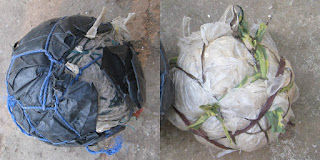
Those who can’t afford soccer balls make them out of string, banana leaves, plastic bags, foil cracker wrappers, and other materials. They’re bound on the outside with yarn (left, diameter ~6”), banana leaves, or strips of fabric (both, right – diameter ~4”).
This kid at Day of the African Child had the biggest homemade soccer ball I’ve seen – it may even be regulation size.

Here are some action shots:


And here are some of the more random t-shirts I’ve been able to photograph. I assure you there are far more random ones that make their way here through the second-hand markets, but I can’t always get a picture.


Those who can’t afford soccer balls make them out of string, banana leaves, plastic bags, foil cracker wrappers, and other materials. They’re bound on the outside with yarn (left, diameter ~6”), banana leaves, or strips of fabric (both, right – diameter ~4”).

This kid at Day of the African Child had the biggest homemade soccer ball I’ve seen – it may even be regulation size.

Here are some action shots:


And here are some of the more random t-shirts I’ve been able to photograph. I assure you there are far more random ones that make their way here through the second-hand markets, but I can’t always get a picture.


Monday, July 5, 2010
Signs of the election


Subscribe to:
Posts (Atom)


