Kinyarwanda is hard for many reasons, but one that continues to dog every Kinyarwanda learner is noun classes.
The noun class is a feature of Bantu languages that has no equivalent in English. It may be compared to the masculine and feminine nouns in French or Spanish, which must be matched to the correct form of an adjective (e.g. a tio gordo and tia gorda, or femme blanche and homme blanc). Still, even German, with its masculine, feminine and neuter, only has 6 permutations when you include singular and plural.
Kinyarwanda has 16 noun classes, marked by prefixes to the noun root. Although some line up with singular and plural (noun class 2 is the plural of noun class 1: umuntu person becomes abantu people, 4 is the plural of 3: imidugudu villages from umudugudu village, etc), there are plenty of irregulars (some class 9 nouns are pluralized with class 10, others class 6).
Sound complicated? That’s not even the hard part! In Kinyarwanda, each noun class not only must be matched by a distinct adjective prefix, but also by a verbal prefix, e.g. Impga nini irya. Additionally each noun class has its own prefix for possessives (impga yanjye, impga zanjye), demonstratives (iki kintu, ibi bintu), direct and indirect objects (which are employed as “infixes” within the verb, between the prefix for the subject and the root).
Confused? Me too.
Showing posts with label Kinyarwanda. Show all posts
Showing posts with label Kinyarwanda. Show all posts
Tuesday, February 1, 2011


Friday, December 10, 2010
Kinyarwanda slang of the day
My favorite bit of Kinyarwanda slang originated at the National University of Rwanda in Butare, to which the country’s most elite students are admitted. When I break this out around NUR-educated Rwandans (and others the slang has spread to) I invariably am received with hearty laughter.
Gutera akadobo (goo-teh-rah ah-kah-doe-boe) means “to throw the little bucket”: to reject someone’s advances. The first time I encountered this phrase, I was told it referred to a woman rejecting a man. I asked if it could also refer to a man rejecting a woman: “That cannot happen!”
Apparently there are levels of rejection. You’ll recall that “aka-” denotes the diminutive class. Therefore, gutera indobo “to throw the (regularly sized) bucket” is a deeper rejection. Most painful, following a relationship of several years, is gutera ingunguru: “to throw the big metal barrel/oil drum.” Ouch.
Sunday, November 28, 2010
Kinyarwanda verb of the month: kumva
When speaking English, Rwandans often make mistakes like “I hear it” when referring to food, or “I touch it” when talking about a sound. This is because Kinyarwanda has only one verb for feeling, tasting, touching, hearing, and even understanding: kumva (koom-vah) “to sense, to understand.” Therefore, simbyumva means “I don’t understand it” but also “I don’t hear it,” “I don’t feel it,” etc etc. It takes some getting used to for Rwandans learning English, but also for those of us learning Kinyarwanda.
Friday, November 12, 2010
Kinyarwanda insult of the day: muzungu kuruhu
Muzungu kuruhu means literally “white person in skin only.” It is an appellation given to white people who do not accede to the various demands for 100 francs, bonbon (candy), bottles, pens, etc. Basically, it’s an insult that means you’re stingy. I like to take it as a compliment - literally, if I’m a muzungu in skin only, I must be very well integrated into Rwanda! On occasion I refer to myself as a muzungu kuruhu to make the point that I don’t have money to give away or sometimes as a bargaining tactic, and when it comes out of my mouth it invariably inspires riotous laughter.
Saturday, October 9, 2010
Kumara masenge

Nowadays, a bunch of 12 or so skinny ones goes for 150-200 rwf, depending on its condition, the location and your bargaining skills. Plumper bunches go for 300 ($.50).
Note that when bargaining for produce, sellers will very rarely lower the prices on pre-arranged groups of items (bananas, stacks of 4-5 passion fruit or tree tomatoes or oranges, piles of carrots or tomatoes). However a skilled bargainer can get something extra thrown in - convince the seller to part with 6 instead of 5 passion fruit for 100rwf, add more carrots to the pile, throw in a couple little green peppers with the stack of cucumbers. Items like pineapples, papayas, and mangoes can usually be bargained for (and sellers always start with a particularly steep markup on mangoes).
Saturday, October 2, 2010
Kinyarwanda verb of the day: Now that’s what I call a Saturday night/Sunday morning
In Kinyarwanda, the verb “to be drunk” is gusinda (goo-sin-dah) and “to be successful” is gutsinda (goo-tsin-dah). These words are dangerously close, although for some notable people the two concepts seem to be intertwined.
Complicating things further, “to pray” is gusenga (goo-sen-gah). In the past tense there is but a subtle vowel difference between narasinze (nah-rah-sin-zay) “I was drunk” and narasenze (nah-rah-sen-zay) “I prayed."
Complicating things further, “to pray” is gusenga (goo-sen-gah). In the past tense there is but a subtle vowel difference between narasinze (nah-rah-sin-zay) “I was drunk” and narasenze (nah-rah-sen-zay) “I prayed."
Tuesday, September 14, 2010
Kinyarwanda false cognate of the day: turifuza
“Turifuza,” which sounds an awful lot like “to refuse (ah),” pops up quite a bit in Kinyarwanda, especially during prayers. It’s the present first person plural of the verb kwifuza, which means to wish. Turifuza (too ree-foo-zah): we wish.
Wednesday, August 18, 2010
Kinyarwanda word of the year: akabenzi
I’ve been in Nyanza for much of the last couple of weeks, first helping prepare Kinyarwanda materials for the group of trainees arriving in October and then at a 2-day in-service language training with half of my group. It’s been a fun time hanging out with my favorite Kinyarwanda teachers and other PCVs. I’ve really gotten my nerd on while writing a Kinyarwanda grammar book.
In this time, I’ve learned quite a bit of Kinyarwanda vocabulary and grammar. The single new word I treasure most is akabenzi.
Felicien, the language coordinator for PC Rwanda, is a jovial man in his mid-20s whom I’ve been calling marume (“uncle”) since the second week of training. Among his many wonderful qualities, he’s smart, funny, a gregarious dancer, and has the absolute greatest beer belly known to man.
The beer belly, you see, is a status symbol for men: it shows that a man has the money to eat and drink well and the leisure not to work it off.
In Kinyarwanda, noun class 12 is the diminutive class. Roots of other nouns can be combined with its prefix, aka- to convey an idea of little, e.g. indobo (bucket) becomes akadobo (little bucket), etc.
Akabenzi literally means “little Benz,” as in Mercedes Benz. It's the little status symbol a man carries around with him: akabenzi, the beer belly.
Thursday, July 8, 2010
Poison
I've known for a few weeks that my colleague B.'s sister is sick. He's even been late to watch a few world cup matches in his own home because he was praying with her. Today on the way back from working in Nyakiliba sector he said we were going to visit her in the hospital in Muhoko sector. Only districts have hospitals, and ours is in Gisenyi, so I asked him, "Do you mean the health center?” No - B. explained that his sister was sick with a mental disorder because she’d been poisoned. The hospital we were going to was a traditional hospital.
I’d heard about the Rwandan belief in poisoning, but this was the first time I encountered it personally. Basically, there are many diseases doctors here can’t diagnose. They lack the technological means to scan a body for cancer and there isn’t a lot of knowledge about invisible illnesses, be they degenerative or temporary. If a doctor can’t diagnose and treat a patient, many times the family (or even the doctor) blames poison, uburozi. “Bamurozi,” they say: they poisoned her. Who is they and why would they want to poison someone? These questions go unanswered. The patient is treated by a traditional healer, an umuganga gakondo, also called a witch doctor. In the case of B.'s sister, the nature of her mental disorder is that she sometimes says things that don't make sense or says non-existent words.
The traditional hospital and witch doctor were not at all what I expected. The hospital was a collection of houses, and the one we entered had several large rooms with 3-4 beds in them and a few small private rooms. All the beds had mosquito nets. Because B.’s family is well off, his sister had a private room. Her son, who is thirteen months old, was with her on the bed. A man came in and talked briefly to B. and his sister; he was well dressed in slacks and a dress shirt. Imagine my surprise when I was told he was the “witch doctor.” According to him, the sister’s condition is improving. After he left, we discussed the child, who has been vomiting and refusing food for a few days and had just vomited up a piece of soap he’d presumably found on the ground. As B. pointed out, the conditions were less than hygienic. Then B. said a lengthy prayer, and we said our goodbyes.
B. is an educated, middle class, religiously Christian Rwandan whom I’ve seen deliver excellent speeches on nutrition and other health topics. Yet he is among many Rwandans who believe in the poisoning phenomenon, and who turn to traditional healers for a cure. He acknowledged that the conditions of the hospital were not clean, and were probably the cause of the child’s illness, but thought that the doctor was healing his sister.
Tuesday, July 6, 2010
Umupira/umupira: Soccer balls and T-shirts
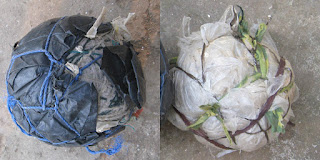
In Kinyarwanda, umupira (oo-moo-peer-ah) means both t-shirt and football (the game and the actual ball). In honor of the World Cup, here are a few pictures of each.
Those who can’t afford soccer balls make them out of string, banana leaves, plastic bags, foil cracker wrappers, and other materials. They’re bound on the outside with yarn (left, diameter ~6”), banana leaves, or strips of fabric (both, right – diameter ~4”).
This kid at Day of the African Child had the biggest homemade soccer ball I’ve seen – it may even be regulation size.

Here are some action shots:


And here are some of the more random t-shirts I’ve been able to photograph. I assure you there are far more random ones that make their way here through the second-hand markets, but I can’t always get a picture.


Those who can’t afford soccer balls make them out of string, banana leaves, plastic bags, foil cracker wrappers, and other materials. They’re bound on the outside with yarn (left, diameter ~6”), banana leaves, or strips of fabric (both, right – diameter ~4”).

This kid at Day of the African Child had the biggest homemade soccer ball I’ve seen – it may even be regulation size.

Here are some action shots:


And here are some of the more random t-shirts I’ve been able to photograph. I assure you there are far more random ones that make their way here through the second-hand markets, but I can’t always get a picture.


Thursday, July 1, 2010
Urusenda
Before I came to Rwanda, one of the things I was most worried about was if I’d be able to eat spicy food on a regular basis. As with much of my pre-Peace Corps fretting, this was misplaced. Urusenda (oo-roo-send-ah) peppers are abundant here. (See: my urusenda poppers.)


Usually Rwandan food is prepared without urusenda; some form of the pepper is served on the side. In restaurants, you’ll typically be given a dish of homemeade hot sauce: spicy oil and mashed urusenda. Sometimes restaurants have the packaged version, called Akabanga. The mass-produced stuff has as much of a pop as the name, which means “little secret” in Kinyarwanda, although I find it to have more raw spice and less of a full flavor than the homemade kind. In private homes, you’re likely to be given either the spicy oil mash or a whole urusenda pepper, slightly cooked, which provides ample heat when dabbed several times onto the food on your plate.


The plural of urusenda is insenda, although this form is rarely used. Given how potent insenda are, I find it to be a perfect cognate, across language groups, with "incendiary."
Friday, June 25, 2010
A Kinyarwanda lesson: pe! and se?
Like English, Kinyarwanda speakers will often put emotion into their exclamations. When they ask questions, the end of the sentence is inflected upwards, as in English.
Normally. But there’s also pe (Pay), which is added to a sentence for emphasis and exclamation. Sometimes you can’t hear the exclamation in the speaker’s inflection; they make their point by using pe. Similarly, se (Say) can be used to signify a question without the upward inflection at the end of the sentence. Both are optional additions to sentences.
Normally. But there’s also pe (Pay), which is added to a sentence for emphasis and exclamation. Sometimes you can’t hear the exclamation in the speaker’s inflection; they make their point by using pe. Similarly, se (Say) can be used to signify a question without the upward inflection at the end of the sentence. Both are optional additions to sentences.
Monday, June 14, 2010
Sinshaka umugabo - I don't want a husband!
I am asked here on a regular basis if I’m looking for a husband, “Urashaka umugabo?” My interrogators may be men (or the boy who just sold me Tigo credit for the last time, I’ll go elsewhere) but also women who ask either with a male relative in mind or out of curiosity.
“Sinshaka umugabo,” I tell them: I don’t want a husband. I might say I’m working now and I will look in two years after Peace Corps, or that Peace Corps won’t allow me to get married and have kids (the good ol’ blame-it-on-Peace-Corps excuse can be applied to many things).
Today I was introduced to a man at the sector office, who said “Umugabo urashaka?” Frustrated that this had come up yet again in a professional setting, I told him “No, oya, Sinshaka umugabo,” only to be told by my coworker that he was just telling me his name: Mugaboshaka. "Man who is needed." Oops.
Saturday, May 15, 2010
Administrative organization of Rwanda
Rwanda has five provinces (intara, “in-har-ah”): North, East, South, West, and Kigali (which lies roughly in the middle). Each province is broken into districts (akarere, “ah-kah-ray-ray”), of which there are 32 in total. Each district has 8-12 sectors (umurenga, “oo-moo-reng-ah”), which are each broken into about 10 cells (akagari, “ah-kah-gah-ree”) and finally cells are divided into about 10 umudugudus each. Umudugudu may be translated as village, but that’s a bit of a misnomer. An umudugudu is an administrative unit that can be a rural community aptly called a village or an urban administrative unit without a distinct identity or somewhere in between.
There are governors for the Provinces, mayors for the districts, and executive secretaries for sectors and cells as well as umudugudu leaders. Services are organized by these units: hospitals in districts and health centers in sectors, offices to register various entities like cooperatives, etc.
There are governors for the Provinces, mayors for the districts, and executive secretaries for sectors and cells as well as umudugudu leaders. Services are organized by these units: hospitals in districts and health centers in sectors, offices to register various entities like cooperatives, etc.
Thursday, May 6, 2010
Ndi umukorerabushake wa Peace Corps!
Translation: I am a Peace Corps Volunteer! Yes, the word for volunteer is eight syllables long. That's "oo-moo-core-air-ah-boo-shah-chay."
I was sworn in as a Peace Corps Volunteer yesterday in a lovely ceremony at the US Ambassador’s residence. After months of training, I was incredibly happy to take the oath. And eat the cake, lasagna, mac and cheese....
The event was filmed and aired on TV that night, and I’ve received multiple comments from other muzungus, the ladies at the bank, etc saying they saw it. Today’s New Times has an article including a picture I’m in – check out my tailor-made dress.

Now I’ve got the weekend in Kigali to enjoy the food (Indian! Ethiopian! Pizza! Burgers! Ice Cream! Mutzig Draught!) and shop for my house, plus build a pantry of goods from the Indian stores and Western supermarkets (cous cous, lentils, spices, chick pea flour, healthy oil…)
Then it’s off to Gisenyi Tuesday to get to work.
Thursday, April 15, 2010
X-rated Kinyarwanda mistake of the day
The story goes that there was a European priest who was learning Kinyarwanda, as any good foreign missionary will do. One day he had a meeting with a man who worked in an office, so he walked in and addressed the secretary, a young and modest Muslim woman. “I’m looking for the man who likes books,” ibitabo, he said. Or tried to say. But what he actually said was “I’m looking for the man who likes ibituba,” or “the man who likes vaginas.”
Sunday, April 4, 2010
In honor of opening day: MLB and pro sports scavenger hunt in Rwanda
Happy opening day. Go Red Sox!
Over the past few weeks, since I saw a Red Sox shirt here in Nyanza, I've seen a number of shirts and hats from MLB teams and decided to keep track of which teams I've spotted. I'll be doing this with all four professional American leagues, so we'll see which league is the fastest for me to complete.
MLB in Rwanda:
Red Sox
Yankess
Cardinals
Angels
Pirates
Diamondbacks
NBA in Rwanda:
Celtics
Kings
NFL in Rwanda:
Eagles
NHL in Rwanda:
nta cyo ("Nah-cho," like the delicious ballpark snack, meaning "nothing" in Kinyarwanda)
Thursday, March 11, 2010
Nyoko! Or, your mama! A lesson in the (Kinya)Rwandan family
Kinyarwanda is a notoriously hard language. We’ve barely touched on the complications of the 16 noun classes (and how all adjectives, possessives, verbs and objects must match each class). Several sounds exist that don’t exist in English, and the spelling is sometimes inconsistent.
Family relations have been a particularly confusing topic, so much that I’ve heard multiple trainees swear they will tell people they have no family. Some of the confusion is due to the fact that Rwandans categorize family relationships differently.
An example of the different categories: to discuss siblings, there are 4 words.
- Mushiki (mu-shee-chee) is used to refer to a male’s sister.
- Musaza refers to a female’s brother.
- Mukuru is an older sibling of the same sex, so a male’s brother or female’s sister.
- Murumuna is a younger sibling of the same sex.
Manageable? Try stepping up to cousins and nieces/nephews.
- Babyara is cousins – but only from your father’s sister or mother’s brother.
- Abavandimwe banjye (literally, “my siblings”) is your cousin by a father’s brother or mother’s sister.
- Similarly, Abana banjye (“my children”) are nieces and nephews from a same-sex sibling’s kids.
- Bisengeneza banjye are a woman’s brother’s kids.
- Bishywa banjye are a man’s sister’s kids.
- Nieces, nephews, aunts and uncles by marriage (e.g. your husband’s sister’s kids) have no appellation.
Complicated! Aunts and uncles are similarly divided – there are separate categories for a father’s sister, mother’s sister, father’s brother, and mother’s brother.
It is understandable that such a different culture and language might have evolved such different concepts of extended family relations and therefore the words to describe them. I can see the internal logic in the system.
What I can’t wrap my head around is that there are separate words for my father/mother/aunt/uncle, your father/mother/aunt/uncle, and his/her father/mother/aunt/uncle. Where English has 4 words for these concepts, Kinyarwanda has 18. If I talk about my mother’s brother, I say marume (ma-roo-may), but if I want to ask about your mother’s brother I must use nyokorome (nyo-ko-ro-may), and a third party’s mother’s brother is nyirarume (nyee-rah-roo-may). At least all possessive nouns don’t function this way.
In summary: My mother? Mama. His mother? Nyina. Yo momma? Nyoko!
(An aside for anyone who’s curious about how I’m describing my nuclear family – The word for mother, mama, is conveniently similar to the word for aunt, mama wacu (wah-choo), which literally means “our mother.” Nobody has been surprised that my ˆ lives with us, or pursued the fact that I don’t have a father. Many people here have conspicuous gaps in their family trees, and it’s rude to pry.)
Monday, March 8, 2010
L, R and foreign words
For native speakers of Kinyarwanda, there is little to no distinction between “l” and “r” sounds. The sound is some combination of the two and “d.” I understand that this presents a challenge for my English-teaching colleagues (nobody wants their students discussing the lice they eat for dinner). It is also challenging when learning the language, partly because “l” and “r” seem to be inconsistently used in spelling.
The l/r issue did present a breakthrough for me with regards to remembering the word for “students.” Umunyeshuri was tripping me up until a different teacher wrote shuli instead of shuri for “classroom” and I suddently saw the German word for school, schul. Of course – the first school teachers here were Germans and Belgians. There is, however, a native word for teacher – umwarimu. Colonists were not the first to impart knowledge to others.
Other foreign imports include ibiro for office (bureau), ifromagi for cheese, ikositimu for suit (French costume), ijaketi for jacket. Kinyarwanda has no other commonalities with anything in my linguistic background, except these colonial imports.
Monday, March 1, 2010
Ni kibazo? Si kibazo. Nta kibazo!
Before I left, I printed some Kinyarwandan vocabulary I found online. Today, I was talking to a few of our LCFs (Language and Cultural Facilitators, one of many PC acronyms). One asked how I found Kinyarwanda. Eager to impress, I grinned and declared it Ni kibazo! (Nee CheeBahZo)
That means “No problem!” Or so I thought.
My comment inspired riotous laughter, which is always encouraging when you’re learning a new language, and an emphatic Oya! (Oh-yah) which might sound like agreement but actually means “no.”
Turns out, ni kibazo means “it is a problem.” I was confusing it with si kibazo (See CheeBahZo), which actually means “it is not a problem” in response to something. You can also say nta kibazo (Nhah CheeBahZo) which means “no problem.” Subtle distinctions.
Ni kibazo and si kibazo now pop up frequently in our conversations, to much amusement.
Subscribe to:
Posts (Atom)


