Followers

Showing posts with label Rwandan public policy. Show all posts

Friday, June 18, 2010

"I use a condom": Popstar PSAs

These three billboards feature some of Rwanda’s biggest popstars, Liza demonstrating that no, you aren’t too large for a condom.


Nkoresha agakingirizo (Nho-ray-shah Ah-gah-chin-jeer-ee-zoh) means “I use a condom.” The print at the bottom says “It is my right to protect myself.”


That’s right, agakingirizo. Some might complain that it takes too long to put one on, but at six syllables, one might argue it takes too long to say.


I’ve had a lesson in viruses and protection this week: my boss’s infected computer nuked my flash drive. I didn’t lose any files (except a few blog posts I’ve rewriten) but the flash drive is not even recognized to attempt a reformat on PC or Mac. It’s an inconvenience for work and a big bummer because I was planning to fill that 8gb with movies and TV when I meet up with other PCVs in a few weeks.

Wednesday, June 2, 2010

Garbage day in Gisenyi

It was garbage day in Gisenyi today. The standard price for trash pickup is 1000 francs; we paid 500 francs (a bit less than a dollar) because we have very little garbage. Most people put their garbage in plastic sacks that formerly held rice, flour, sugar, etc, but we use paper bags. Although we paid around 8:30 am, by nightfall the trash on our street was still sitting outside of people’s gates and doors (see picture, from a gate on my street – it was picked up the next day).


When school got out for lunch just before noon, I noticed children clad in school uniforms sorting through garbage bags to retrieve anything of value. In a corner of the market, a crowd of people stood around a garbage mound, clamoring over old shoes covered in trash – I suspect this had something to do with trash collection day, although I’ll keep my eye out for it on other days.

So what happens to the sacks that get left outside doors and, for those who have them, gates? The garbage gets carted away in trucks rented cheaply from the Congo. It gets dumped in a field about 7km away from town, with no treatment. This means chemicals from batteries and all sorts of other crap leaches into the soil. I hope to visit the dump when I get my bike in a few months.

I’ve heard some rumors about trash in Gisenyi (I haven’t been able to double check these, but then this is a blog and not a newspaper so journalistic standards don’t quite apply). The government owes the trash company lots of money that maybe was collected in taxes. Before the government stopped paying, trash pickup was free for all, but now they only collect from those who can pay (the money going towards truck rentals and salaries). What happens to those who can’t pay? According to one person I talked to, “it is necessary to pay” and if someone can’t, “they must move out of town to the village.” When I pointed out that this wasn’t practical, he argued that if you can’t afford to pay for garbage collection, you can’t afford to live in town. In reality, those who can’t afford the fee are forced to burn their trash, which is also how people in rural areas deal with their garbage. Burning trash presents both health and environmental issues.

Thursday, May 27, 2010

Promoting participation in the coming election

Rwandans will vote for president on August 9. As a PCV I can’t share my opinions on politics, but I can write about the procedures and the government’s efforts to promote participation. This election awareness logo is popping up on t-shirts everywhere. It incorporates the date of the vote, colors of the Rwandan flag, and a thumb that I assume represents the ink that will mark those who have participated.

Primaries began last month for the ruling party, the RPF. Following Umuganda on the last Saturday in April, the governor and mayor of Nyanza spoke to the assembled crowd about the organization of the coming elections, informing them of the schedule and encouraging them to participate. From what I can gather, each umudugudu voted on two candidates, before advancing to subsequent votes at the cell, sector and district levels before provinces voted on the two candidates (I posted about Rwanda's administrative organization here).

Current president Kagame won the national RPF primary. According to the New Times (Rwanda’s main paper), the national election commission said "As far as we are concerned as the electoral commission, we are not informed of any opposition." However, the campaign officially spans from July 20 to August 8.

In addition to speeches at public gatherings such as umuganda and numerous radio messages, Rwanda is conducting rather unique get out the vote efforts. Barbers and moto drivers, Rwandans who come in to contact with high volumes of captive customers in their lines of work, have been trained to conduct get-out-the-vote outreach with their customers. Pretty creative!

If you are interested in learning more about the upcoming election, much has been written and many perspectives exist. I recommend googling for more information; Peace Corps prevents me from saying more.

Saturday, May 15, 2010

Administrative organization of Rwanda

Rwanda has five provinces (intara, “in-har-ah”): North, East, South, West, and Kigali (which lies roughly in the middle). Each province is broken into districts (akarere, “ah-kah-ray-ray”), of which there are 32 in total. Each district has 8-12 sectors (umurenga, “oo-moo-reng-ah”), which are each broken into about 10 cells (akagari, “ah-kah-gah-ree”) and finally cells are divided into about 10 umudugudus each. Umudugudu may be translated as village, but that’s a bit of a misnomer. An umudugudu is an administrative unit that can be a rural community aptly called a village or an urban administrative unit without a distinct identity or somewhere in between.

There are governors for the Provinces, mayors for the districts, and executive secretaries for sectors and cells as well as umudugudu leaders. Services are organized by these units: hospitals in districts and health centers in sectors, offices to register various entities like cooperatives, etc.

Saturday, May 1, 2010

Goat notes

By Rwandan law, goats must be tied up when left to graze. People mostly adhere to the law, much to the chagrin of this particular goat.

Incidentally, it is taboo here to drink goat milk. Rwandans’ disdain for goat milk stems from their utter reverence for cows; goat milk is seen as a disparaging substitute for cow milk. People who consume goat milk do so in utter secrecy for fear of being shamed by their communities. In a country where many struggle with malnutrition, this situation is particularly unfortunate: goats cost $10-20 whereas cows cost at least $100.

The taboo against dairy products does not extend to goat meat, which is a common food, although many Rwandans believe goat meat will cause women to grow beards.

If you’re curious about cows in Rwanda, my Colleen posted an excellent essay on the topic.

Saturday, April 24, 2010

Umuganda

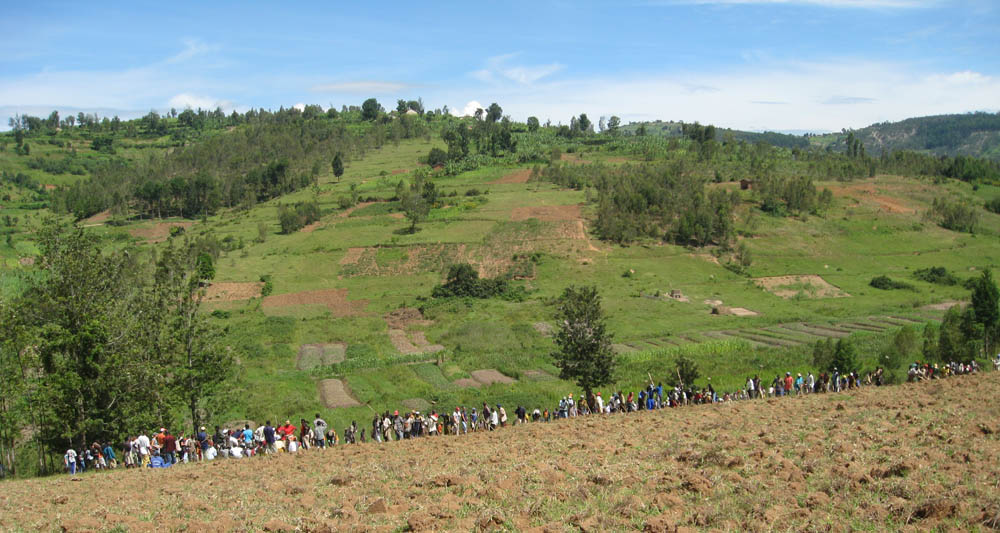
Today was the last Saturday in April, so many of us trainees headed back to the field we helped hoe last month. This time I brought my camera.

Today’s activity was turning the soil again to break it up, and then planting cassava. Sticks from cassava plants were delivered by truck from Kigali, broken up into 6-8 inch pieces with sprouts, or “eyes,” and partially buried in the dirt with the eyes pointing up towards the sun.

When the cassava is grown, it will either be distributed to the poor or sold to raise money for a project in the local area.

I was very impressed that both the Mayor of Nyanza district and the Governor of the entire Southern Province turned out to help. The governor was hard at work but was kind enough to let me take his picture. He is below, with a hoe overhead. (He’s very sporting in an outfit of a Nike hat, Fila shirt, and Adidas pants; Reebock should endorse him as well.)


The Mayor is above, roughly center in the white polo shirt, pioneering an interesting hoeing technique. He’s a helpful and friendly man who has made us very welcome in Nyanza.

After a few hours of work, the crowd gathered to hear the Mayor and Governor speak about the organization of the August elections. 

Those who participate in Umuganda get pink record cards with space for their village and cell officials to endorse their attendance. As you can see, this card begins in April (the 4th month) and has space for a year. I am told that if a person is involved in a local dispute they may present their Umuganda participation card to demonstrate their credibility as a good citizen. In some parts of Rwanda, failure to contribute to Umuganda may incur a fine.

Saturday, March 27, 2010

Umuganda

Bill Clinton recently cited umuganda as one of the reasons he admires President Kagame. On the last Saturday of every month, Rwandans do volunteer projects in their communities. This morning we joined a group of several hundred people in preparing a field to plant cassava. We started around 9:30 and by 11am most of the field had been hoed. The group celebrated by singing and dancing, and then several people made speeches and recognized participants including the Peace Corps, contingents from various umudugudus (villages) and a group of secondary school students.


Visitor Stats

  © Blogger template Simple n' Sweet by Ourblogtemplates.com 2009

Back to TOP