Showing posts with label Rwanda tourist sites. Show all posts
Showing posts with label Rwanda tourist sites. Show all posts
Sunday, March 13, 2011
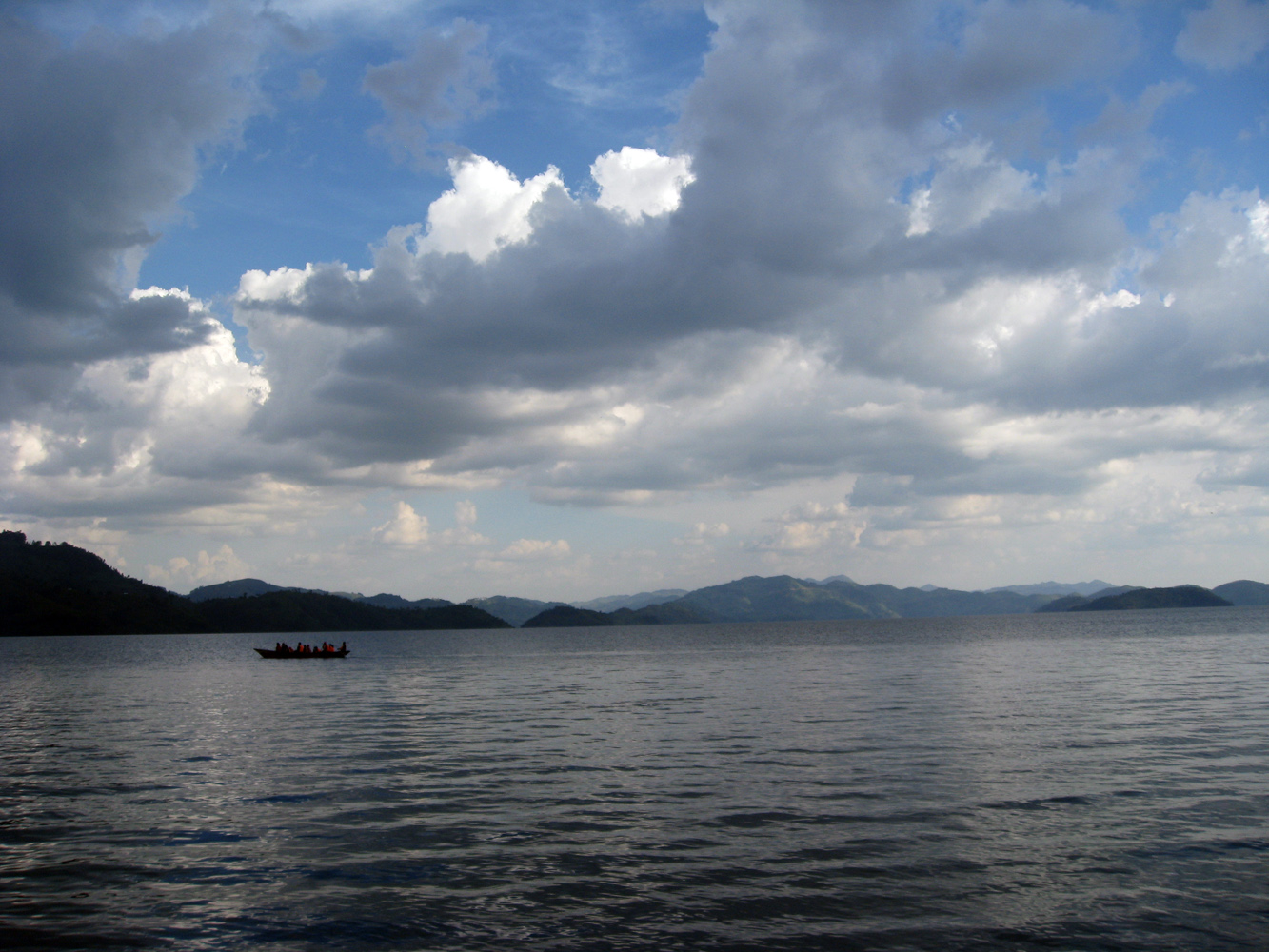
Lake Burera


Friday, December 10, 2010
Chimpanzees
Rebecca, the scientist who is studying Gishwati’s chimpanzees, kindly offered to take me out with the research team for a glimpse of the chimpanzees. This group of about 20 is at the very beginning stages of habituation, meaning that they are not entirely accustomed to human visitors. Very few people have ever seen these chimps. It was an amazing opportunity.
We set out around 10am to meet the morning team, which had presumably been following the chimps since daybreak. When we found them around noon, after a brisk uphill hike that left me embarrassingly winded, the morning team had lost the small number of chimps they’d been watching. We did hear a few chimps hooting in the not-too-far distance, so we went off-trail, up and down steep hillsides that further reminded me I need to work out more. We were hot on their trail - following the paths of trampled bushes and broken vines they’d left in their slides downhill, noting wads of spit out bark or bites taken out of leaves. I was exhausted and thinking of exiting the forest with the morning team to try again another day when, very nearby, a great chorus of whoops rose from the trees.
I stuck around, and was treated to several hours of chimpanzee viewing: a mother and infant eating in a tree, the bold male who I thought of as the class clown selecting the closest appetizing tree to us for his meal, chimps swinging from trees and vines, the very unappealing swollen red bottom of a chimp in heat, chimps wadging bark, chimps eating leaves, chimps scratching and grooming, chimps building nests. What incredible creatures they are, and it is a privilege to work with the organization charged with protecting them.
Thursday, August 12, 2010
Ice Cream in Butare!
I finally got myself down to “Rwanda’s first ice cream parlor” in Butare. First let’s correct a few inaccuracies in the Gothamist article: Rwanda has had excellent (if pricier) ice cream at Bourbon for several years, this “ridiculously warm” country rarely gets hotter than 85 degrees and is usually a pleasant 75, I highly doubt they are locally sourcing processed sugar (and can you make ice cream from branches of local sugar cane?), and diversifying the market for milk-based products is all well and good but a scoop of ice cream costs more than what 60% of Rwandans make in a day and you can’t have an ice cream culture without widespread refrigeration which you can’t have without widespread electricity.
That said, they have decent soft-serve, with two flavors at any given time. Although I’ve heard rumors of mango and chocolate, when I visited there was vanilla and coffee. The vanilla was very milky tasting and the coffee was good but not strong. I’d rather pay a bit more for Bourbon’s richer and creamier offerings. However, you can taste the freshness in the ice cream in a way I’ve never experienced, and for that it’s a must for any itinerary that passes through Butare.
The granola topping is amazing, the banana cake is even better, but the absolute highlight is the real live bagels. I took one home, toasted it, improvised cream cheese from laughing cow cheese mixed with diced veggies and herbs, and enjoyed my first bagel in 6 months.
There were a few groups of affluent Rwandan university students enjoying ice cream when I was there. It was nice to see that the shop is catching on with some of Butare’s inhabitants.
Also, the women are very nice, take pride in their work, and the customer service was far and away the best I’ve encountered in Rwanda. For that alone it is worth the visit.
Sunday, July 25, 2010
Bisoke

I climbed my first volcan today: Bisoke. At 3,711 meters, Bisoke’s is the middle height of Rwanda’s five volcanoes, but the trail covers the biggest altitude change in one day and is said to be among the hardest and muddiest climbs. (I’ll let you know how it stacks up after I get around to climbing the other four.) Bisoke is most notable for the crater lake at its summit.
We left Gisenyi before light and were treated to an amazing view of the rising sun over fog-filled valleys, above. Upon arrival at Volcanoes National Park, we paid or fees and drove 30-40 minutes over a terrible road, littered with volcanic rock. Patience, our wonderful guide, called the bumpy ride an “African massage.” We set off at about 9:20, a late start.


During the first hour or so we climbed past neat rows of crops and entered the forest. It’s possible to see animals like buffalo and occasionally gorillas on the hike; the closest we got was seeing their excrement. (Buffalo, left; gorilla, right). To protect us against any animal encounters, however, we were accompanied by several soldiers who did the grueling hike with rifles. They assured us the safeties were on.
About an hour into the hike we reached a clearing where the bath to Diane Fossey’s Karisoke research camp diverges from the path to Bisoke’s summit. From there, it was over two grueling hours to the top.


Along the way, we passed through several distinct vegetation zones. In the dense part of the forest there were plenty of stinging nettles growing close to the path. As the guide said, “Nature is well organized;” the leaves of the plant below produce a milky substance that somewhat reduces the pain caused by the nettles. (When I say somewhat, I speak from experience: on the way down they got my elbow and finger.)

This huge tree right by the path was at least 400 years old, according to Patience.

The path eventually changed from thick mud through the forest to a mud-and-grass mix with more open space.


Towards the top there was a beautiful turquoise bird.

There were times throughout the last hour when I thought I wouldn’t. get to the top, but I made it! I had to get bundled up; it was cold. Fog rolled in and out at a rapid speed, sometimes obscuring the bluff on the other side of the lake.


The vegetation at the top was really interesting:


Here’s a panorama. It was really gorgeous, but I had to pass on the offer to hike down to the water: there’s no way I could have made it back up again. I did walk a few minutes up the hill until the soldiers said to stop: Bisoke lies on the Congolese border, and the highest point is technically in Congo.

The way down was tough, and took almost as long as the way up. During the ascent, mud represented a threat to forward progress and the volcanic rock made convenient steps. On the way down, the rocks became death traps and mud was a friendly cushion for sore legs and knees. I soon gave up on being clean and competed with one of my friends for who could fall the most. Between exhaustion and the thin air, much giggling occurred on the way down.
After we passed the Diane Fossey clearing, we took a different way than we’d came: a narrow path through dense jungle. Along the way we passed this rainbow cucumber-like fruit that the guide said is a favorite among gorillas.


We finished around 5pm, walking like drunks with legs of jelly. I’ll be sore all week!
Thursday, July 22, 2010
Bralirwa


5 km outside of Gisenyi, in a beautiful spot on the lake, is Bralirwa: the factory that brews all of the Primus, Mutzig and Guinness sold in Rwanda. They use roads and a boat to distribute beer all over the country. The factory is run on methane extracted from Lake Kivu.

Tours are currently available on Thursdays. We weren’t charged, although I’ve heard that it sometimes costs 5000rwf. We showed up just before 11 and were asked to write a letter requesting to tour (this might be better done further in advance, but my hasty English and Kinya translation on a piece of notebook paper did the trick). After a short wait, we were allowed to join a group that seemed to have planned in advance (maybe they paid?). The tour was mostly given in French, and the employees were very amenable to answering questions. I highly recommend it if you’re anywhere near Gisenyi.
Here are some covert snaps – the sign is unfortunately blurry, but on either side of the guy’s gaping arm wound are gears.

Sugar waiting to be added to beer. Ew.

I think this is the fermenting hall. Most of the tanks were making Primus, with a few on Mutzig and Guinness. They said it takes 2 weeks to make a batch of beer, including fermenting and then cooling.

The very modern lab has a typical wooden bottle opener. They test the beer to make sure it conforms to the formula, has the proper alcohol content, and is free from pathogens.

The coolest part of the tour was the bottle room. They gave us protective glasses because sometimes bottles explode. Here there are machines that take empty returned bottles from the crates, steam clean them, fill them with new beer, cap them and label them.


The tour ended in the office area, where there was a bar complete with a dart board. I managed to finish off a Guinness and a couple small Mutzig before they cut us off. Below, the Bralirwa business model – take a look, it’s good unintentional comedy.

Saturday, July 10, 2010
Gishwati Forest

When you hear someone in Rwanda say, “we must move beyond the tragedy of what happened here,” your thoughts immediately jump to the genocide. In the case of Gishwati forest, this statement refers to the massive deforestation that has taken place over the last 80 years, and the current optimism about conservation efforts. At one time, Gishwati stretched across a vast section of Western Rwanda and was home to chimpanzees and countless other plants and animals. Rwanda’s incredible population density has driven the deforestation, and by the 1980s much of the forest was either farmland or pastures for cows, which are very common in the region. (Upon returning to town, I was asked if I had brought back any milk.) Following the genocide, refugees from the Congo resettled in the area, further reducing the size of the forest.
Today, Gishwati has diminished to a sliver of its original grandeur. In addition to the smallholder farms and pastureland that have replaced centries-old trees, locals have planted eucalyptus groves both in the forest’s former footprint and inside the remaining forest. Eucalyptus is a non-native plant that’s fast-growing and highly profitable when converted into timber. For the desperately poor people in the surrounding district of Rutsiro, the remaining forest contains timber and other valuable resources, such as fruit for eating or bark for basket making. As the population continues to grow, people are sometimes at odds with the forest and its inhabitants: for example, chimps raiding nearby corn fields.

The deforestation has left a band of 13-15 chimps isolated from other forests in Rwanda. It has increased the already massive erosion problem in the area (landslides in the surrounding districts displaced hundreds earlier this year). Some say that conserving what remains of Gishwati is impossibly ambitious. However, the Great Ape Trust’s Forest of Hope project is working to reforest the area, study the chimps, increase local awareness of environment issues, and expand local livelihoods opportunities that would encourage a symbiotic rather than extractive relationship with the forest. According to the website, they’ve grown the area of the forest by 67% in less than three years. The people I met who work with Forest of Hope were a dedicated and talented bunch, and I'm optimistic on their behalf.
Here are some photos from my 7-kilometer hike through the forest.


Below left, a tree the forest was named for. Right, a tree stump which could probably serve as a parking spot for a small car.


This next picture has got to be a metaphor for something, but I'll leave that to your imaginations.


This slug was so big it had its own bugs along for the ride. FYI, I wear a women's US7.5.


Shortly after we arrived at the waterfall, it started to pour: a welcome relief in the dry season.


The rain made me nervous about my camera (for a while I tucked it into the ziplock that had held my lunch) but it brought out this giant earthworm, maybe the coolest site of the hike.

In many spots the path passed charred remnants of charcoal production, one of the deforestation culprits.


Several of these signs surround the forest to address the problem of locals using it as a toilet:
 It’s not allowed to defecate here
Don’t destroy life
And the environment in general
If you are caught you will be punished
Finally, on the ride back north to Gisenyi I snapped a stereotypical "Land of a Thousand Hills" photo. The emerald blanket of tea in the foreground is common in much of northwestern Rwanda. The brown on the left has been recently harvested. The hills go on forever; no photo can do them justice.

Monday, May 3, 2010
Off the beaten track: the Nyanza market
If you’re traveling in Rwanda and want a unique local experience, you might consider visiting Nyanza at about noon on a peak market day. Peace Corps Volunteers and our fabulous trainers come from all over the country, and everyone agrees that the best and cheapest second-hand clothes shopping is found in Nyanza. On Monday and Thursday, the back section of the market is crowded with women sorting through clothes heaped on tables or piled on tarps on the ground.
Brand names abound: Gap, H+M, American Eagle, Zara’s, J Crew, Tommy Hilfiger, Calvin Klein, etc. Just be sure to inspect for stains, holes, and missing buttons. Counter intuitively, silk and other blouses are cheapest, as low as $.09 (RWF 50), while T-shirts and tank tops (Old Navy and Target abound) might cost you as much as $.70 (RWF 400). On the male side, Armani and other designers can be found for $.90 (RWF 500). In addition to great clothes, you are sure to find some laughs at relics of errant fashions past, be they neon or ruffled.


Nyanza is also home to the former King’s residence and the Rwesero Arts Museum, both worth a visit.
The district capital, the town of Nyanza lies just off the main Kigali-Butare (Huye) road, with buses directly from Kigali (2 hours, RWF 1400) and Butare (40 minutes, RWF 500). The Volcano bus station is across from the market in a courtyard with the Nyanza Sun buffet, a solid post-shopping lunch option (RWF1000). If you’re feeling like Western food, head just uphill from the Kobil station to the Hotel Heritage ($2.50-$5; croque madame and ham sandwich recommended but avoid the “Pizza”).
And if you feel like making a detour on the way to Nyanza, be sure to check out Gatagara Pottery.
Subscribe to:
Posts (Atom)


