Followers

Showing posts with label cooperatives. Show all posts

Wednesday, June 23, 2010

A goat cooperative, continued

In the past few weeks, I’ve experienced an extended period of mild frustration. It seems like I do a lot of sitting around in the office, which makes me feel unproductive in the present but is definitely part of a crucial process of observation and establishing relationships. I’ve also been frustrated by the number of times promising plans get canceled (a related issue, as it leaves me with nothing to do) and by constantly having no idea what’s going on, why it’s happening (or isn’t happening), and what’s going to happen. Still, I’ve been looking for the positives.

Today was a great example of this: although I largely sat in the office with nothing to do, there was an hour of pure success. It started with my suggestion a few days ago that my colleague W. with his degree in agriculture and animal husbandry visit the ailing goat cooperative, one of B.’s projects. For the past few days I’ve been gently pushing the subject, suggesting times when both are free to visit. A few obstacles had to be overcome, for example whose budget would pay for the moto fuel and when the cooperative members were available. But today it finally happened.

W. gave a speech to the assembled cooperative members about how goats can eat everything, particularly table scraps and leaves and stalks of various crops. I asked a few leading questions like “After I finish eating corn, can I give the inside to the goats to eat?” W. also discovered that water is scarce in the community and suggested they feed the goats several parts of plants that retain water.


Although only time will tell if this was effective, I’m optimistic and we'll do followup. I’m claiming a victory here: I served as the catalyst, getting W. and B. to collaborate. The next step is for B. to realize when he needs to ask for W.’s expertise in the future without my prodding. 

When I took out my camera to get “before” pictures of the goats in our weight-gain program, I was mobbed by village children screaming “jyewe” (me) and “Inanjye” (and mine). Here are a few adorable shots that also show the severity of malnutrition among the village’s children.


And the village itself, a place where great natural beauty contrasts with the malnutrition and poverty. The villagers are decked out in their Sunday best for their meeting with us.

Tuesday, June 8, 2010

A goat cooperative

Today I visited a cooperative that raises milk-producing goats. I wanted to visit these guys because I thought maybe they’d need help marketing goat dairy products due to the cultural taboo against them. It turns out, their problem is much worse: the cooperative of about 430 people bought 6 females and 1 male of an expensive variety that produces good dairy products – but they can’t afford to feed the goats, so they aren’t producing any milk. There were 3 babies there, including one born 2 days ago and just as cute as you’d imagine. The mothers were sickly and a fourth baby had recently died. This area was extremely rural and the people were so poor that they could barely feed themselves, let alone the goats. It was a bit of a hopeless moment for me: What do I know about goat nutrition? Nothing. How can I help these people get the money to feed their goats, now, before they lose any more of their investment? I can’t in any sustainable way. How can I help my organization foresee and prevent such problems in our work with other cooperatives?


Pictured is a typical rural goat pen I saw yesterday; I wasn’t comfortable using my camera today.

Thursday, April 22, 2010

More on Gatagara Pottery

Last week I returned to Gatagara Pottery as part of training, first to conduct a needs assessment and then to do a presentation. 

The Pottery cooperative was originally founded in the 1970s when European ceramists helped set it up using local materials, fusing modern ceramic technology and traditional pottery methods of the Twa. Before 1994, the cooperative supported up to thirty families, but lost some twenty members during the genocide. In 1997 a European charity helped the Pottery restart. Today they have ten members who receive a monthly salary. All are male (they expressed the belief that previously women were not considered strong enough for their work, but today they would be welcome). Their main challenge is finding customers: some weeks they receive none or one customers in Gatagara, and their only other markets are one shop in Kigali and one hotel in Nyungwe. One or two times a month they receive orders for products. 
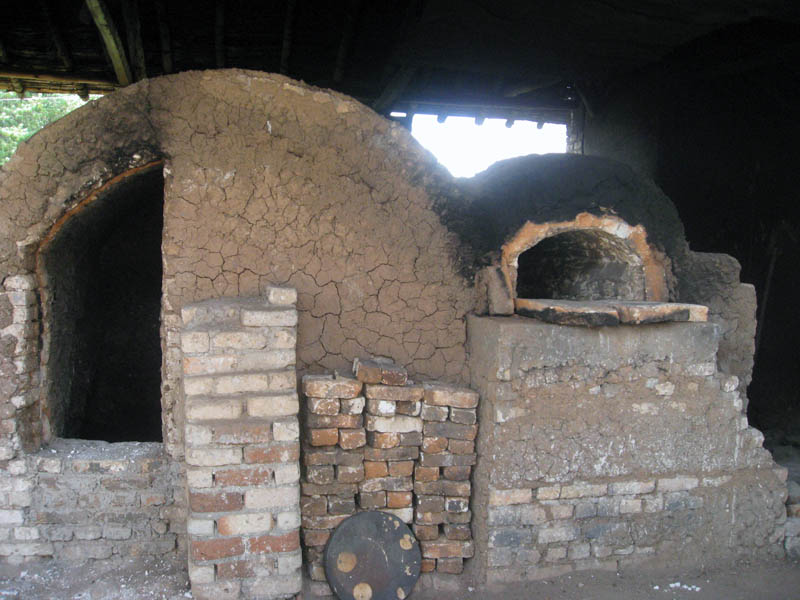
Nearly all the materials are found within 1-15 kilometers from Gatagara: Clay, kaolin, bricks for the kiln, and materials for the glazes including feldspar, talc, iron oxide, and ashes of eucalyptus, straw and hay. Only sieves and a few components of the glazes are imported from Belgium. They can store the clay for up to several years. They throw on both manual and electric wheels, do an initial bisque firing at 950-1000 degrees Celcius, then glaze the ceramics and fire them again at 1300 degrees.
Their work is very high quality, but their self-promotion has been limited. In our presentation, we spoke to them about techniques they could use to market themselves. We recommended that they improve their bare-bones sign on the main road to advertise a demonstration and gift shop. We also provided them with contact information for various hotels and tourism agencies, and demonstrated a phone call with a hotel to ask about sending visitors to the Pottery or selling their products. Although we had to overcome a few communication issues, hopefully our advice was useful to the cooperative.

Friday, April 9, 2010

Rwandan potters

Today we visited a cooperative near Nyanza that makes incredible pottery. Pictures below:


Visitor Stats

  © Blogger template Simple n' Sweet by Ourblogtemplates.com 2009

Back to TOP